Understanding Heavy Metal Contamination and EPA Standards
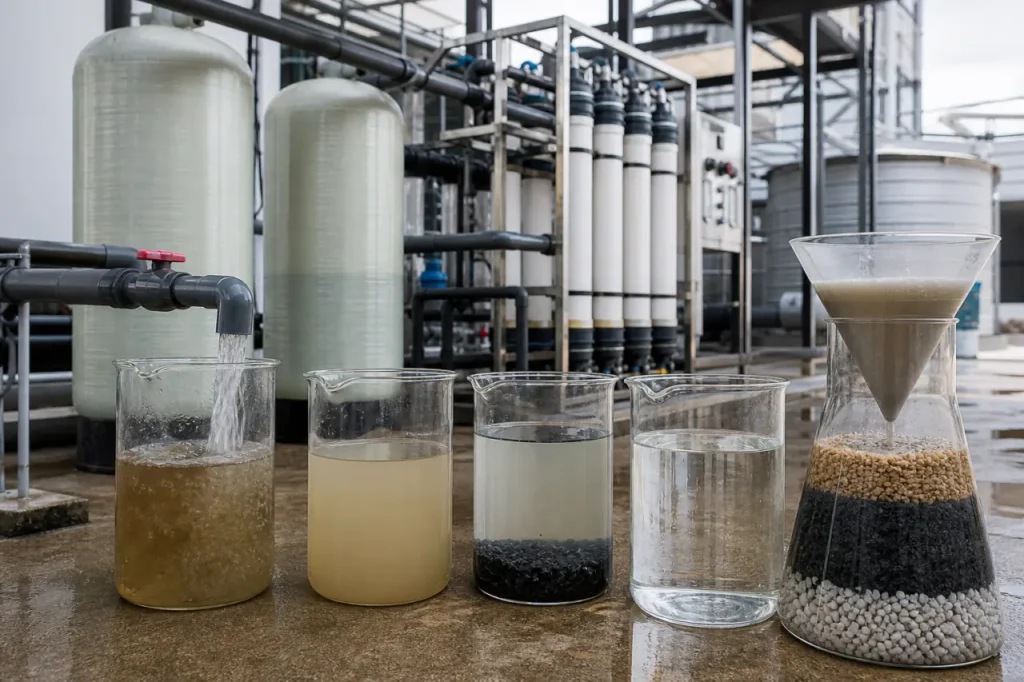
How do you remove heavy metals from water effectively? The answer starts with recognizing that these contaminants exist as dissolved ions, not suspended particles.
A standard sediment filter or mesh screen will not catch them. You need a chemical or physical separation process that targets ions at the molecular level.
Heavy metals enter water through natural mineral deposits, corroded plumbing, industrial discharge, and agricultural runoff. Once dissolved, they are invisible, odorless, and tasteless. The only way to confirm their presence is laboratory water testing.
Common Heavy Metals Found in Water Systems
The heavy metals most frequently flagged in water quality reports share a common trait: they are toxic even at trace concentrations. Their danger lies not in acute poisoning at typical environmental levels, but in bioaccumulation over years of low-level exposure.
| Heavy Metal | EPA Action Level / MCL | Most Effective Removal Method | Alternative Method |
|---|---|---|---|
| Lead (Pb) | 0.015 mg/L (action level) | Reverse Osmosis | Pertukaran Ion |
| Arsenic (As) | 0.010 mg/L (MCL) | Adsorption (Iron-based media) | Reverse Osmosis |
| Mercury (Hg) | 0.002 mg/L (MCL) | Presipitasi Kimia | Activated Carbon (catalytic) |
| Chromium (Cr VI) | 0.100 mg/L (MCL) | Pertukaran Ion | Reverse Osmosis |
| Cadmium (Cd) | 0.005 mg/L (MCL) | Reverse Osmosis | Presipitasi Kimia |
These EPA action levels represent the legal threshold where a public water system must take corrective measures. For private well owners, there is no regulatory mandate, which makes voluntary testing and treatment the only safety net.
The Dangers of Dissolved Ions
Dissolved heavy metal ions behave differently from particulate contaminants. They travel freely in solution, bonded to water molecules or other compounds. This is why boiling water does not remove them.
The heat vaporizes the water but leaves the metal ions behind, concentrating them in whatever remains.
The health effects depend on the metal, the concentration, and the duration of exposure. Lead accumulates in bones and soft tissue, affecting neurological development in children.
Arsenic is a carcinogen linked to skin, bladder, and lung cancer. Mercury targets the kidneys and central nervous system. Cadmium, even at low doses, can cause renal tubular damage over time.
What makes dissolved ions difficult to treat is their size and charge. A lead ion is measured in angstroms.
Most osmosis terbalik berkapasitas tinggi rely on semi-permeable membranes with pores small enough to reject these ions, but the specific rejection rate varies by metal species, pH, and competing water chemistry.
Core Chemical and Physical Removal Mechanisms
Separating heavy metals from water requires exploiting specific physical or chemical properties: ionic charge, molecular size, boiling point, or chemical reactivity. Each method works, but no single method excels at every metal in every water condition.
Reverse Osmosis (RO) dan Filtrasi Membran
Reverse osmosis uses a high-pressure pump to force water through a semi-permeable membrane. The membrane rejects dissolved ions while allowing water molecules to pass. Typical rejection rates for heavy metals range from 90% to over 99%, depending on the membrane type and operating conditions.
cURL Too many subrequests by single Worker invocation. To configure this limit, refer to https://developers.cloudflare.com/workers/wrangler/configuration/#limits.
cURL Too many subrequests by single Worker invocation. To configure this limit, refer to https://developers.cloudflare.com/workers/wrangler/configuration/#limits.
cURL Too many subrequests by single Worker invocation. To configure this limit, refer to https://developers.cloudflare.com/workers/wrangler/configuration/#limits.
cURL Too many subrequests by single Worker invocation. To configure this limit, refer to https://developers.cloudflare.com/workers/wrangler/configuration/#limits filtrasi membran lanjutan cURL Too many subrequests by single Worker invocation. To configure this limit, refer to https://developers.cloudflare.com/workers/wrangler/configuration/#limits.
cURL Too many subrequests by single Worker invocation. To configure this limit, refer to https://developers.cloudflare.com/workers/wrangler/configuration/#limits
cURL Too many subrequests by single Worker invocation. To configure this limit, refer to https://developers.cloudflare.com/workers/wrangler/configuration/#limits.
cURL Too many subrequests by single Worker invocation. To configure this limit, refer to https://developers.cloudflare.com/workers/wrangler/configuration/#limits.
cURL Too many subrequests by single Worker invocation. To configure this limit, refer to https://developers.cloudflare.com/workers/wrangler/configuration/#limits.
cURL Too many subrequests by single Worker invocation. To configure this limit, refer to https://developers.cloudflare.com/workers/wrangler/configuration/#limits.
cURL Too many subrequests by single Worker invocation. To configure this limit, refer to https://developers.cloudflare.com/workers/wrangler/configuration/#limits.
cURL Too many subrequests by single Worker invocation. To configure this limit, refer to https://developers.cloudflare.com/workers/wrangler/configuration/#limits cURL Too many subrequests by single Worker invocation. To configure this limit, refer to https://developers.cloudflare.com/workers/wrangler/configuration/#limits cURL Too many subrequests by single Worker invocation. To configure this limit, refer to https://developers.cloudflare.com/workers/wrangler/configuration/#limits.
cURL Too many subrequests by single Worker invocation. To configure this limit, refer to https://developers.cloudflare.com/workers/wrangler/configuration/#limits
cURL Too many subrequests by single Worker invocation. To configure this limit, refer to https://developers.cloudflare.com/workers/wrangler/configuration/#limits.
cURL Too many subrequests by single Worker invocation. To configure this limit, refer to https://developers.cloudflare.com/workers/wrangler/configuration/#limits.
cURL Too many subrequests by single Worker invocation. To configure this limit, refer to https://developers.cloudflare.com/workers/wrangler/configuration/#limits.
cURL Too many subrequests by single Worker invocation. To configure this limit, refer to https://developers.cloudflare.com/workers/wrangler/configuration/#limits cURL Too many subrequests by single Worker invocation. To configure this limit, refer to https://developers.cloudflare.com/workers/wrangler/configuration/#limits cURL Too many subrequests by single Worker invocation. To configure this limit, refer to https://developers.cloudflare.com/workers/wrangler/configuration/#limits.
cURL Too many subrequests by single Worker invocation. To configure this limit, refer to https://developers.cloudflare.com/workers/wrangler/configuration/#limits.
cURL Too many subrequests by single Worker invocation. To configure this limit, refer to https://developers.cloudflare.com/workers/wrangler/configuration/#limits
cURL Too many subrequests by single Worker invocation. To configure this limit, refer to https://developers.cloudflare.com/workers/wrangler/configuration/#limits.
cURL Too many subrequests by single Worker invocation. To configure this limit, refer to https://developers.cloudflare.com/workers/wrangler/configuration/#limits.
cURL Too many subrequests by single Worker invocation. To configure this limit, refer to https://developers.cloudflare.com/workers/wrangler/configuration/#limits.
cURL Too many subrequests by single Worker invocation. To configure this limit, refer to https://developers.cloudflare.com/workers/wrangler/configuration/#limits
cURL Too many subrequests by single Worker invocation. To configure this limit, refer to https://developers.cloudflare.com/workers/wrangler/configuration/#limits pengolahan limbah industri, cURL Too many subrequests by single Worker invocation. To configure this limit, refer to https://developers.cloudflare.com/workers/wrangler/configuration/#limits.
cURL Too many subrequests by single Worker invocation. To configure this limit, refer to https://developers.cloudflare.com/workers/wrangler/configuration/#limits.
cURL Too many subrequests by single Worker invocation. To configure this limit, refer to https://developers.cloudflare.com/workers/wrangler/configuration/#limits.
cURL Too many subrequests by single Worker invocation. To configure this limit, refer to https://developers.cloudflare.com/workers/wrangler/configuration/#limits.
Presipitasi kimia cURL Too many subrequests by single Worker invocation. To configure this limit, refer to https://developers.cloudflare.com/workers/wrangler/configuration/#limits.
cURL Too many subrequests by single Worker invocation. To configure this limit, refer to https://developers.cloudflare.com/workers/wrangler/configuration/#limits
cURL Too many subrequests by single Worker invocation. To configure this limit, refer to https://developers.cloudflare.com/workers/wrangler/configuration/#limits.
cURL Too many subrequests by single Worker invocation. To configure this limit, refer to https://developers.cloudflare.com/workers/wrangler/configuration/#limits.
| Teknologi | cURL Too many subrequests by single Worker invocation. To configure this limit, refer to https://developers.cloudflare.com/workers/wrangler/configuration/#limits | cURL Too many subrequests by single Worker invocation. To configure this limit, refer to https://developers.cloudflare.com/workers/wrangler/configuration/#limits | Skala Industri | Keterbatasan Utama |
|---|---|---|---|---|
| Reverse Osmosis | 90-99% | cURL Too many subrequests by single Worker invocation. To configure this limit, refer to https://developers.cloudflare.com/workers/wrangler/configuration/#limits | cURL Too many subrequests by single Worker invocation. To configure this limit, refer to https://developers.cloudflare.com/workers/wrangler/configuration/#limits | cURL Too many subrequests by single Worker invocation. To configure this limit, refer to https://developers.cloudflare.com/workers/wrangler/configuration/#limits |
| Pertukaran Ion | 85-99% | cURL Too many subrequests by single Worker invocation. To configure this limit, refer to https://developers.cloudflare.com/workers/wrangler/configuration/#limits | cURL Too many subrequests by single Worker invocation. To configure this limit, refer to https://developers.cloudflare.com/workers/wrangler/configuration/#limits | cURL Too many subrequests by single Worker invocation. To configure this limit, refer to https://developers.cloudflare.com/workers/wrangler/configuration/#limits |
| Adsorpsi | 70-98% | cURL Too many subrequests by single Worker invocation. To configure this limit, refer to https://developers.cloudflare.com/workers/wrangler/configuration/#limits | Pressure vessels with media beds | Limited capacity, breakthrough risk |
| Distilasi | 99+% | Countertop batch distiller | Multi-effect distillation plants | High energy cost |
| Presipitasi Kimia | 85-99% | Not practical at household scale | Clarifiers, thickeners, filter presses | Sludge disposal requirement |
Point-of-Use (POU) and Household Systems
Household systems prioritize simplicity, low maintenance, and a small physical footprint. An under-sink RO unit with a dedicated faucet provides heavy metal protection at the point of use.
Whole-house ion exchange or adsorption columns treat all incoming water but are limited by flow rate and pressure drop.
The most common mistake at the household scale is skipping the raw water analysis. Without knowing which metals are present, their concentrations, and what competing ions exist, a purchased system can be mismatched.
A water softener does not remove lead. A standard carbon filter does not remove arsenic.
Municipal and Industrial Wastewater Treatment
Industrial applications must meet effluent discharge permits, which often specify metal limits in parts per billion.
Industrial water purification plants combine multiple treatment stages: equalization tanks to smooth flow and chemistry, chemical precipitation for bulk metal removal, clarification, sand filtration, and often a final polishing step with RO or ion exchange.
Monitoring is continuous. pH, conductivity, ORP, and sometimes online metal analyzers provide real-time data. A single equipment malfunction or chemical dosing error can release a slug of untreated wastewater, triggering a permit violation.
The penalty for non-compliance is not just a fine, but potential production shutdown.
Emerging Technologies in Heavy Metal Filtration
Research teams are developing new approaches that target lower energy consumption, reduced chemical use, and more selective metal recovery. Two technologies have moved from laboratory proof-of-concept to pilot-scale demonstration.
Capacitive Deionization (CDI)
Capacitive deionization uses charged porous electrodes to remove metal ions from water. When a voltage is applied, cations migrate to the negatively charged electrode and anions to the positive electrode. The ions are temporarily stored in the electrical double layer at the electrode surface.
CDI operates at ambient pressure with no membrane and no chemical addition. Energy consumption is much lower than RO for brackish water with moderate metal concentrations.
When the electrodes become saturated, the voltage is reversed or short-circuited, releasing the ions into a concentrated brine stream.
The technology is currently limited to lower TDS waters and has not yet displaced conventional methods for high-concentration industrial streams.
Biosorbents and Natural Materials
Molecular dynamics research has demonstrated that natural materials, including spent coffee grounds, citrus peels, banana peels, and chestnut shells, can bind heavy metal ions through their functional groups. Plant flavonoids and agricultural waste contain hydroxyl and carboxyl groups that act as natural ion-exchange sites.
The promise is a low-cost, renewable treatment media for regions where conventional treatment plants are not economically feasible.
However, the adsorption capacity is lower than engineered media, and the biomass must be replaced or regenerated frequently.
Biosorbents remain an active research area rather than an off-the-shelf technology for municipal or industrial use today.
Pertanyaan yang Sering Diajukan
Does boiling water remove heavy metals?
No. Boiling water kills bacteria but does nothing to remove heavy metals. In fact, as water evaporates during boiling, the volume decreases and the concentration of dissolved lead, arsenic, or mercury actually increases. Only distillation, which captures and condenses the steam separately, eliminates heavy metals.
Will a standard refrigerator or pitcher filter remove lead and arsenic?
Most basic carbon filters reduce chlorine taste and odor but are not certified for complete lead or arsenic removal. A filter must be tested to NSF/ANSI 53 for lead reduction to provide reliable protection.
Arsenic requires specialized iron-based media or RO. Check the performance data sheet for the specific contaminants the filter is certified to address.
Are heavy metals absorbed through the skin during showering?
For non-volatile heavy metals such as lead and cadmium, dermal absorption from shower water is minimal. The primary risk is ingestion.
Mercury in some forms can volatilize, but this is usually an industrial exposure concern. For most households, point-of-use treatment at the kitchen tap is the first priority.
Whole-house treatment may be warranted when multiple family members have elevated blood levels or when the water supply contains volatile compounds.
Next Steps for Water Quality Verification
cURL Too many subrequests by single Worker invocation. To configure this limit, refer to https://developers.cloudflare.com/workers/wrangler/configuration/#limits.
cURL Too many subrequests by single Worker invocation. To configure this limit, refer to https://developers.cloudflare.com/workers/wrangler/configuration/#limits.
cURL Too many subrequests by single Worker invocation. To configure this limit, refer to https://developers.cloudflare.com/workers/wrangler/configuration/#limits.
cURL Too many subrequests by single Worker invocation. To configure this limit, refer to https://developers.cloudflare.com/workers/wrangler/configuration/#limits.
cURL Too many subrequests by single Worker invocation. To configure this limit, refer to https://developers.cloudflare.com/workers/wrangler/configuration/#limits.
cURL Too many subrequests by single Worker invocation. To configure this limit, refer to https://developers.cloudflare.com/workers/wrangler/configuration/#limits.
cURL Too many subrequests by single Worker invocation. To configure this limit, refer to https://developers.cloudflare.com/workers/wrangler/configuration/#limits.
cURL Too many subrequests by single Worker invocation. To configure this limit, refer to https://developers.cloudflare.com/workers/wrangler/configuration/#limits cURL Too many subrequests by single Worker invocation. To configure this limit, refer to https://developers.cloudflare.com/workers/wrangler/configuration/#limits.